
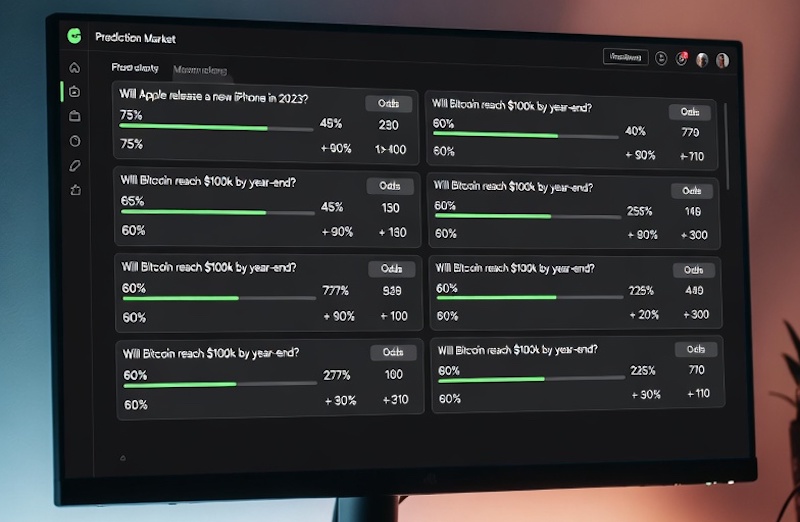

Prediction markets, the evolution of novelty bets and polls, currently banned in many countries and in Italy but a topic at the center of many European regulators’ agendas.
They used to be called “novelty bets“, now they are transforming into prediction markets or predictive markets. And some bookmakers (see Dazn) are eyeing some companies that are growing rapidly like Polymarket to link these markets to sports betting and all kinds of betting. A problem that many markets are already addressing and others, like Italy, will soon have to address even though some sites are already known to ADM offices. But let’s proceed in order.
Predictive markets
Prediction markets are trading platforms where users buy and sell contracts tied to the outcome of future events (political, economic, sports). The price of contracts reflects the collectively perceived probability that an event will occur. Common synonyms are prediction markets, event contracts or “social forecasting” platforms.
The mechanism is based on the “wisdom of the crowd” to predict results and is very similar to polls. The topics addressed by the markets are politics, economics, sports events, obviously, but also current affairs and even geopolitics.
Institutional investors use these markets to hedge against specific uncertainties, such as an adverse election result. The questions are very simple and based on the YES/NO mechanism. Each event is traded as a binary contract (yes, it will happen; no, it won’t happen). The probability transforms into a price and if you guess the prediction correctly you collect, simply, otherwise you lose the bet. The boundary with betting is really very thin as you can see.
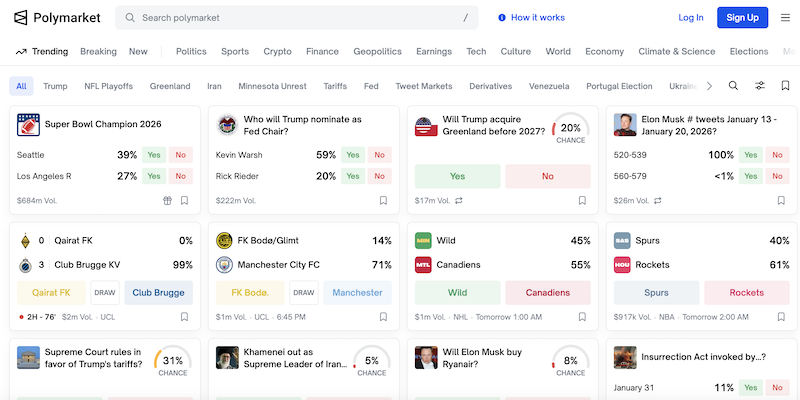
The main platforms are Polymarket (decentralized on blockchain) and Kalshi (regulated in the USA and which is already at the center of many events but also some controversy).
They often prove more accurate than traditional polls in predicting complex events. Advantages over polls Economic incentive: Users put real money at stake, pushing them to inform themselves and make more accurate predictions compared to simple opinion polls.
Italy’s position
Taking Polymarket and Kalshi as reference, the two main predictive sites are in a legal gray area in Italy: the Customs and Monopolies Agency has included it in the past in the list of blocked sites for lack of license, but subsequently temporarily removed the block pending a TAR ruling, due to its decentralized nature based on blockchain and different operation from traditional bookmakers (without central bank, uses stablecoins like USDC). Despite this, access is often limited or blocked, and the platform itself restricts access based on jurisdiction for regulatory compliance, while the use of cryptocurrencies (USDT, USDC) for transactions is common but subject to tax and AML regulations, with the Bank of Italy emphasizing that virtual currencies have no legal tender.
Just try to sign up with Kalshi which reports Italy among the non-enabled countries while Polymarket initially allows registration only to then report the inability to participate in predictions.
Obviously the fact that these sites have a decentralized nature and operate on blockchain could represent an obstacle to proceeding with regulation.
Let’s not forget that in Italy political betting is banned to avoid influencing election results. However, polls, often even on samples of a few thousand citizens if not hundreds, are proposed daily and even close to political or administrative electoral consultations.
What’s happening in the States?
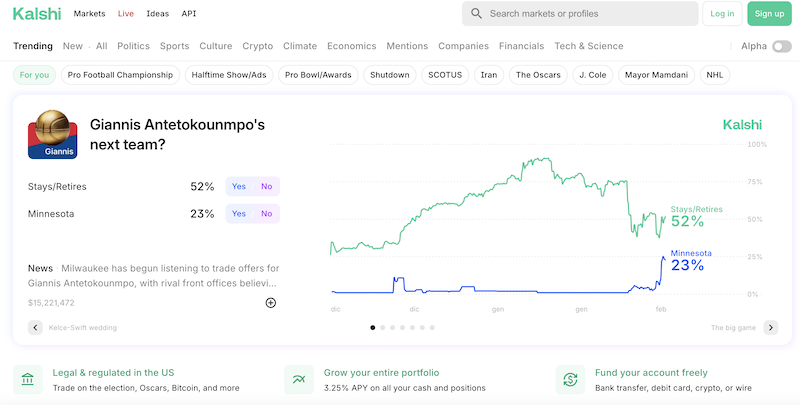
News about prediction markets in foreign media is now daily. In view of the Super Bowl, for example, the Attorney General of New York State, Letitia James, warned that “citizens must be aware of the significant risks of unregulated prediction markets”.
Even in the USA, where sports betting is now regulated in almost all states, prediction markets are in a gray area. “So-called prediction markets do not enjoy the same consumer protections as regulated platforms. I urge all New Yorkers to pay attention to protect their money,” James further commented.
Kalshi has engaged in a series of legal battles with 34 attorneys general after suing the New York Gaming Commission. In a formal opinion, the prosecutors established that operators like Kalshi practice illegal gambling if they do not have a sports betting license. Could the solution to legalize these platforms after a tug-of-war be closer than we think?