
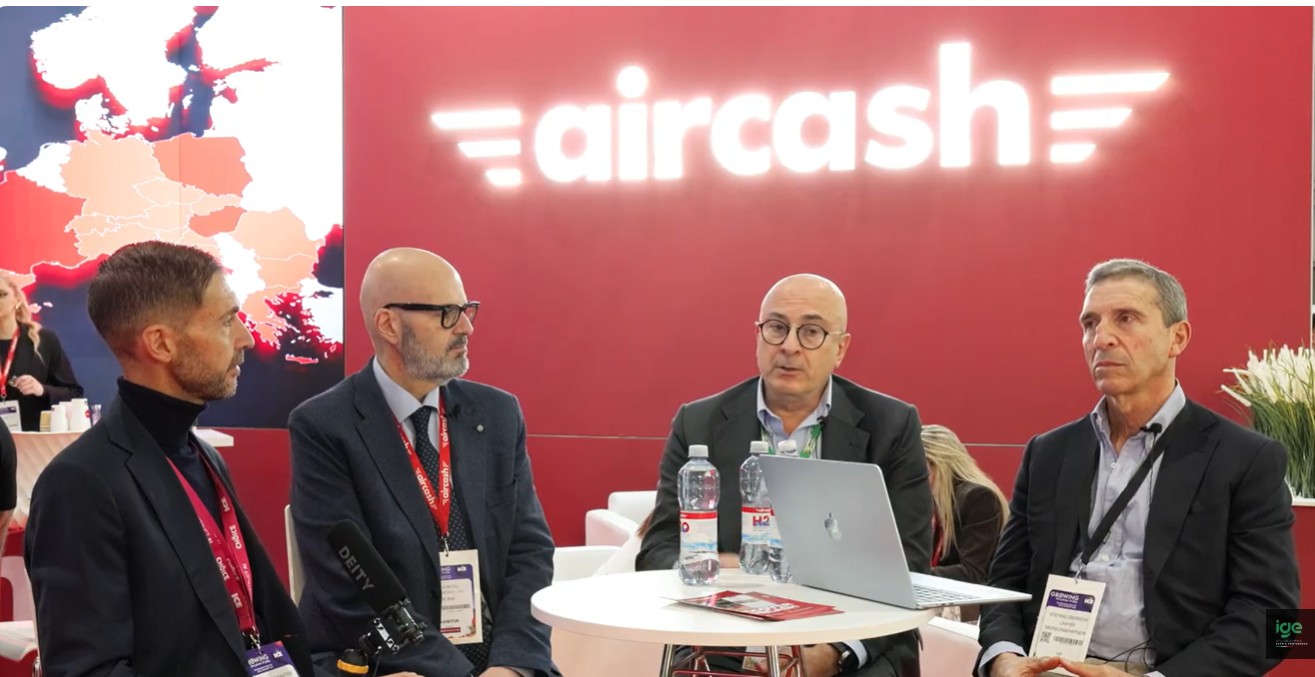

With a talk dedicated to Gaming and Payment during the ICE fair, new opportunities and risks of regulation on PVR are outlined.
Barcelona – The Italian online gaming market is preparing for the implementation of the PVR (Points of Sale for Recharges) regulation, which imposes various new rules on operators. Although its implementation has been repeatedly postponed, due to appeals filed with the Lazio Regional Administrative Court, creating prolonged uncertainty in the market. Despite the delays, the regulation remains an integral part of the Italian regulatory roadmap.
A tangled situation that we wanted to delve into with IGE Magazine during the ICE Barcelona 2026 fair, bringing together some experts in the field at the Aircash stand, a specialist in payment systems and a leading operator in the market. In a talk aimed at clarifying the current state of regulation, the practical implications for operators, and what to expect once the regulation comes into force. To do this, we gathered Mattia Nicelli, Country Specialist Italy at Aircash, Marco Castaldo, CEO of Microgame, and lawyer Stefano Sbordoni, founder of Sbordonipartners, under the moderation of Alessio Crisantemi, Director of IGE Magazine / ItalianGamingNews.it.
Lawyer Sbordoni is tasked with framing the current situation occurring at the regulatory and judicial level regarding payment with a focus on the PVR topic.
“The PVR is somewhat the sore point of the reform – explains the lawyer – in the sense that it is still under the judgment of the competent courts, in this case, the Lazio Regional Administrative Court. The PVR is a concept we know, which originated long ago, in 2007, even in 2006, and from there it has taken various forms. Today it is the point of contact between physical and online, and for this reason, it represents both a bulwark and a problem to be solved. In the administration’s idea, actually of the government, because decree 41 of 24, which started the reorganization of games dealing with online, provides in article 13 precisely the figure of the PVR establishing its register, where it is stated that these points of sale, let’s say that at the points of the current panel, is what takes place at the point of sale, therefore the payment of the game account recharge that interests us. This article 13 in its 5 paragraphs outlined some peculiarities of the PVR, including the establishment of the register and the traceability, reporting, and enforceability of the operations carried out at the PVR.”
“Until today – continues Sbordoni – we know and do not know that the use of the PVR is somewhat more flexible by some, many, few operators, because ‘in and out’ operations are carried out that do not find a direct response in the regulations. Precisely to limit these operations, this article 13 has provided both the register and the famous limit under discussion of 100 Euros of cash recharge per week per customer, which has created enormous turbulence in the market, the operating conditions, therefore no cash out nor payment of winnings and the recognizability of the PVR through the placement of an external plaque or an identifiable QR code. The standard contract that must be signed and which is communicated in its essential elements by the administration itself is precisely the obligation to use payment instruments that ensure the traceability of the transaction, therefore cash with that limit we mentioned, while for other methods if they are for example ‘scratch’ or other they must be brought back to the cash limit.
All this point by point, but in particular the register and the 100 Euro limit are under judgment because some operators have challenged this rule at the Lazio Regional Administrative Court and we find ourselves at a final postponement which then rose to the Council of State because there was a judgment that then went on appeal, Council of State September 26, 2026, next date. Here arises that uncertainty of applicability that according to some institutions actually exists, as I described it, according to others must await the outcome of the judgment. So outcome postponed as said to September.”
With Marco Castaldo, we explore instead the impact that this regulation has had and is having on the market. It is evident that the legislator’s reaction is to increase the levels of security, responsibility, and market control, but partly because of how the regulation was perhaps conceived, partly also this situation of uncertainty, as lawyer Sbordoni said, the impact seems to be particularly critical at this stage.
“The impact on the PVR sector is certainly very significant, let’s say at a first level because clearly, there is less, or at least there is a seriously restrictive rule on the ability to use cash as a means of payment at the point of sale, which is one of the key elements of the PVR model, historically. In the long run, the market will certainly adapt and reorient towards other means of payment to ensure the necessary traceability. The real issue is the transition, because at this moment for the reasons well explained by Stefano and also because the new concession regime is operational, but the new technical rules regime is not yet, it should come into force theoretically on May 13 and it is the new technical rules that will allow, oblige, but also allow for the necessary changes being made on gaming platforms, to respect this cumulative recharge limit. At this moment it is a somewhat paradoxical situation, because the regulation exists, is in force, from a certain point of view is under judgment and on the other hand, there are no technical tools to enforce it. The market is experiencing a moment of great uncertainty, where it is operating as before with some distinctions, but in general, I don’t think anyone enforces the cumulative recharge, precisely because there are not yet, the platforms have not yet been adapted to do so, many do not even adhere to the single recharge limit for the 100 Euros. Therefore it is an objectively difficult situation, with many uncertainties, which however in the long run, I conclude, will have a significant impact, because the recharge mechanism at the point of sale, if replaced by new mechanisms, will clearly generate a cost for the supply chain, which will necessarily require a restructuring, a redistribution of the supply chain’s remuneration, with commercial effects that could be significant.”
With Mattia Nicelli, we try instead to understand if, despite these non-trivial difficulties and uncertainties of this moment, once this regulation is in place, there will be opportunities and what they will be according to you for sector operators and also for consumers. “As far as we are concerned, we return to the experience previously made in other European community countries since Aircash owns an electronic money license in Europe, we have had this experience in other countries, we are exporting it to use a term from the banking world also in Italy and we offer it to gaming operators. We have this solution that brings cash to digital with complete KYC and therefore recognition of the person making that transaction at that moment and we entrust the digital to the operator’s game account. So we offer this opportunity to the gaming operator in Italy to solve for them all that part linked to the project’s compliance. So there will indeed be opportunities.”
Returning to Stefano, again despite this complexity he has just described, far from trivial, but according to you what could be the scenarios or possible solutions to overcome this impasse?
“Being the meeting point between physical and online, it could find a home with regulatory regulation of multichannel. If multichannel were to be included in a first or second level law text, then all those operations, including Pvr, that straddle the two worlds would find a solution. Let’s remember that in so-called land-based gaming agencies, there is no limit except for the general law of 5,000 Euros in cash transactions per individual or per transaction, because there is guaranteed anonymity for those accessing the physical gaming point at the agency, and therefore they do not have to use traceable tools to place their bets.
Then it is the concessionaire agent, in turn, the owner of the agency, who must report and therefore has obligations towards the granting administration. This is where the Pvr, straddling both sides, finds itself in the impasse we know.”
Marco Castaldo; what could and should be done, perhaps even immediately, to better manage and resolve the situation? “Given that the ideal outcome for me would be to adopt a different scheme to recover the original model with perhaps some adjustments for player identification, because I personally believe that the rule as it is was not necessary, but let’s look ahead, since the rule exists: the solution, in my opinion, is to address it in a segmented way, understanding the market and the different segments of players, points of sale, player habits, converting players towards traceable means such as Aircash, and I believe the success of this conversion largely depends on how gaming operators and payment service providers work together to ensure a satisfactory user experience, in some respects as close as possible to what was before, but not necessarily, so in this logic, in my opinion, those who manage to turn this problem into an opportunity are those who, in partnership with payment operators like Aircash, can adapt the processes and user experience to allow them to continue playing safely according to their previous habits, and I must say that with Aircash we have found great flexibility in reasoning with us on how to adapt the user experience, always remaining within the regulatory framework, respecting compliance 100%, so in my opinion, this is the direction to work towards.”
Mattia Nicelli explains why working with an authorized payment institution brings advantages for the operator. “We conduct multiple onboarding processes, and every operator, before being able to work with us, goes through the tight meshes first of the bank that issued our license, which transmits to the Bank of Italy, which in turn returns an informative and says yes, okay, and we do the same things but at a different level with the registrants, so we offer a solution to an adaptation of what is the gaming world in Italy so that the entire experience of the operator and the player can align with what today the law and regulations and lawyers teach us to do. In an attempt to simplify life for everyone, therefore, onboarding with us is immediate, it takes very little time, as far as integration with them is concerned, we are flexible, we listen to what they need, and consequently, we adapt what are ours, so we have a response to the requests more than ample where they come from.
We try to provide it to them even now almost at zero cost because, as Marco said, you cannot impact an already burdened supply chain that every year has something new and complicated to carry forward.”
The challenge, therefore, is not trivial, from all points of view: but as Marco rightly said, at the center of everything must always be the user experience because the final result is that any evolution and change must stand and, above all, must make sense for the player.”